1 | Malting
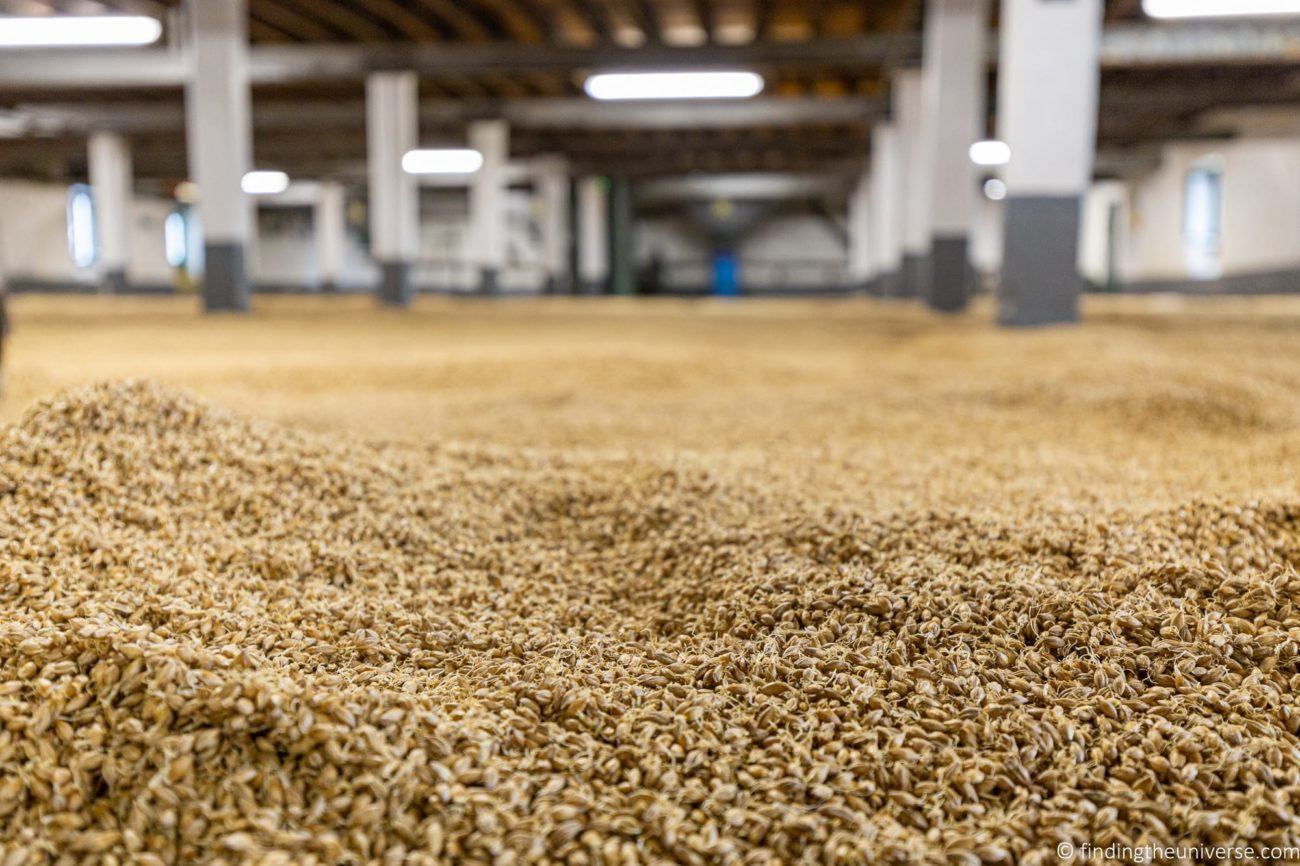
Barley harvested from the field is loaded with starch. Malting turns this starch into sugar, which is needed to produce alcohol. Compounds, such as nitrogen, in the barley will affect the final yield. The barley is soaked in cold water for 24 hours. This swells the grain and raises moisture content from 5% to 55-60%.
Traditionally, this was spread across a long stone malting floor to a depth of six inches. It must be turned regularly to distribute heat in earlier days and prevent roots and shoots knitting together in the latter days. After six days the process is complete.
The grain is dried to prevent it growing into a plant and using the sugar itself. Traditionally, this took place in a kiln with the malted barley resting on a mesh floor above. Until recently this was fuelled by peat, which burns quickly with plenty of heat and smoke.
Nowadays, much commercial malting is completed in a large drum, which slowly turns to prevent the heat and knitting issues. The action creates a sand dune effect. After six days the barley is blasted with hot air to dry it. The result is malted barley or simply, malt.
2 | Milling
This is the first part of the process that most distilleries do themselves. Prior to milling, the malted barley is passed through a filter to remove stones, debris, or foreign objects. Most distilleries have a two-roller milling system – the first rollers crack the husks, while the second set are closer together to crush the grain.
The result is called grist. The ratio of husk, middle and flour must be perfect – too much flour and everything will glue together when water is added, too much husk and the water will drain straight through.
3 | Mashing
This is where the sugar is extracted from the malt. The grist is loaded into a large vessel called a mash tun and warm water added. The mixture is stirred using large interior paddles or rods and sugars and enzymes in the barley pass into solution. This is drained through the meshed floor of the mash tun and collected.
Then water at a higher temperature is added. This extracts further sugars and enzymes. This occurs three times at most distilleries with average water temperatures being 65°C, 75°C and 85°C. The resulting sugary liquid is called wort. The husky residue, known as draff, is collected, dried, and often used as animal feed.
4 | Fermenting
The wort is cooled to around 30°C and passed to a huge tank called a washback. These are usually made of stainless steel or wood. Yeast is added and begins to feed on the sugar, producing alcohol and carbon dioxide. Liquid yeast is commonly used, which speeds up the initial time for this process to begin. Fermentation is the first part of the process that can have an influential effect on the final spirit.
The yeast’s job is done after 48 hours with all sugar turned to alcohol. Many distilleries take the liquid at this point, which is now called wash, to distil. However, many leave the wash for a longer period. This creates extra depth, complexity and fruity characteristics as the yeast cells die. The wash is 7-8% ABV.
5 | Distilling
The copper pot stills are a key point where a distiller can control and influence the flavour and character of their spirit. The shape and size of stills are a major factor in this – simply put, tall stills make light, delicate spirit while shorter stills produce heavy and oily spirit. Across Scotland there are stills of all shapes and sizes, providing huge diversity. Copper is also great at purifying alcohol vapours.
First distillation takes place in the wash still. This is the larger of the two stills. The wash is pumped into the pot and heated. Alcohols begin to evaporate around 65-70°C and vapours rise, travelling along the neck and attached lyne arm. Once they hit the condenser, which is a series of copper tubes surrounded by cold running water, the vapours are pressurised and return to liquid form. This is called low wines and has an alcoholic strength of approximately 25% ABV.
Second distillation takes place in the spirit still. The low wines are heated in the pot and different alcohols rise at different stages. Foreshots come first – these are very high ABV, pungent and full of undesirable compounds. Next come the hearts. These are the alcohols collected as new make spirit to be matured in oak casks. They come off the still as a transparent liquid at approximately 65% ABV. Finally come the feints – these are weak, cloudy and again contain undesirable compounds.
6 | Maturing
To legally become Scotch whisky the new make spirit must mature in oak casks in Scotland for a minimum of three years. The most common types of oak used are from America or Europe – American oak (Quercus Alba) and European oak (Quercus Robur).
During maturation the spirit interacts with the wood, moving in and out of it, extracting natural compounds as it does. This is aided by toasting or charring the inside of the barrel prior to filling. This invigorates the compounds and caramelises natural sugars in the wood. It also cracks the oak to give a larger surface area to present to the maturing spirit.
The cask is said to give up to 75% of the flavour to a whisky, plus all colour. Over time the level of liquid within the barrel will drop – wood is porous and as whisky breathes some will naturally evaporate. This is called the angel’s share. In Scotland the average is about 1-5-2% per year. The alcohol level also drops by approximately 0.5% ABV annually.
The location of a warehouse will also have an impact on flavour and character. Factors such as temperature and humidity are different in different places – by the coast versus inland, valley versus hillside, urban vs remote island. As the whisky breathes the natural surroundings will add influence. This is why some people say that coastal whiskies have a distinct salty tang.