Distillery Profile: Edradour

Edradour was founded in 1825 by a group of local farmers under the name of Glenforres.

For many years, the Edradour distillery (pronounced edd-ra-dow-er) in the centre of the Highlands was Scotland’s smallest single malt producer. However, the recent craft and artisan distilling movement has seen many smaller distilleries open across Scotland over the last 15 years. Despite this, it retains its cult status amongst whisky drinkers.


Now Edradour is not even in the Top 20 smallest distillery list, such has the growth been. The quaint farm distillery is one of Scotland’s most photogenic and is like stepping back in time to how whisky used to be produced using traditional skills and no automation. The name Edradour is derived from the Gaelic ‘edred dobhar‘, meaning ‘the stream of King Edred’.

A Bit of History

Edradour was founded in 1825 by a group of local farmers under the name of Glenforres. The group would later form John MacGlashan & Co. and operate under that name. It was built within farm buildings in the hills outside the Highland town of Pitlochry. The name was changed to Edradour in 1837 to reflect the distillery’s proximity to the Edradour Burn.

In 1933, William Whiteley & Co. purchased Edradour due to the quality of its malt whisky and popularity with blenders. Later, the early 1980s saw significant change – Pernod Ricard took control, built a visitor centre and released the first ever single malt.

The current owners, the independent bottling company Signatory Vintage, picked up the baton in 2002. They have grown the range of single malts, raised the distillery’s profile and tripled the spirit production in recent years. However, the visitor centre is currently closed, having never reopened after the Covid pandemic.

Background

Throughout much of its history, the single malt from Edradour was consumed by local people in the Highlands or sold for use in blends. The robust style of the spirit, which is made in the smallest legal size of still, made it desirable to blenders. Edradour was famously an ingredient in the King’s Ransom blend, which counted Winston Churchill and Joseph Stalin as fans.

Edradour single malt did not appear on the market until 1986. The current owners, Signatory Vintage, are one of the most active to experiment with maturation in different casks from different origins. This includes Port, Sauternes, Madeira, Burgundy, Chardonnay and Super Tuscan red wine and a plethora of other spirit casks.

The Geeky Bit

The former smallest distillery in Scotland was expanded in 2018 and now produces 340,000 litres of spirit per year. This is spread across two sites – the old farm distillery and the new extension. There are two mash tuns, each with a 1.1-ton capacity. They run one mash per week in the old distillery and two per week in the new.

There are eight wooden washbacks in total with two fermentation times operated – one short at just 50 hours and one long at 120 hours. There are a pair of stills in each stillhouse. Edradour’s classic new make spirit is unpeated but for a short period each year they distilled a heavily peated single malt spirit. This is named Ballechin (pronounced bal-ee-kin).

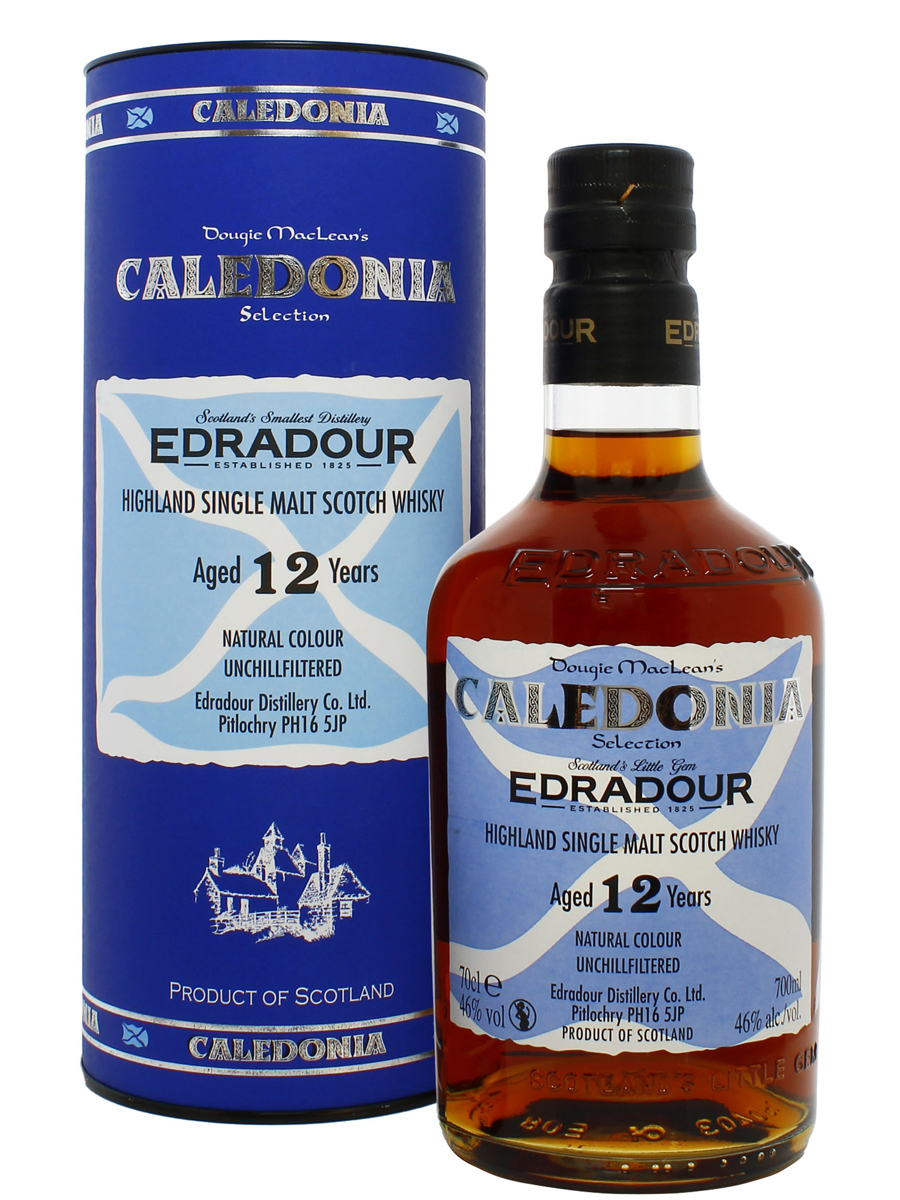
One To Buy | Edradour 12 Years Old Caledonia

This bottling forms part of Edradour’s compact core range and is inspired by Dougie Maclean’s famous song, Caledonia. It is released in small batches but is a constant within the range. Initial maturation is in ex-bourbon casks, and this is followed by a lengthy secondary maturation of five years in ex-Oloroso sherry casks.

Expect plenty of richness and sweetness with honey drizzled dried fruits (especially raisin, sultana and fig) to the fore. Robust malt, milk chocolate and cocoa notes add depth, while baking spices (think of cinnamon and nutmeg) add late dryness and complexity.


by Matt Chambers
Master of Whisky at Whisky 1901
26/02/2025

Download our investment guide

Whisky is increasing in value more rapidly than any other luxury asset class including diamonds and gold. Download your copy of the investment guide.

Download


**Disclaimer**: Important information. Please read carefully before making any purchase. This communication is for informational purposes only and does not constitute financial or investment advice. Whisky 1901 Ltd is not a regulated financial institution and is not authorised by the Financial Conduct Authority (FCA). Any references to “investment,” “broker,” “adviser,” or similar terminology are used descriptively only and should not be interpreted as regulated financial services.

Whisky 1901 Ltd does not provide financial or investment advice, does not assess suitability, and does not make recommendations. Any decision to purchase whisky casks is made solely by the customer, based on their own judgment and, where appropriate, independent professional advice.

Whisky is sold as a physical, tangible asset and not as a financial product. Purchasing whisky carries risks that differ from regulated investments such as stocks or bonds, and customers should make purchase decisions independently and based on their own research.

Key Risks and Considerations:

1. Please be aware that whisky casks are unregulated in the UK and that the value is variable, meaning it can both increase and decrease. 

2. Understand that you have 14 days to change your mind and request a full refund under our cooling-off period.

3. All Clients of Whisky 1901 Ltd must be aged 18 years or older to make a purchase, in accordance with UK law and regulations regarding the sale of alcohol to minors.

4. Please note that the volume of spirit will decrease over time due to evaporation, known as “the Angels’ share”.

5. Please be aware that “New Make” spirit must be matured for a minimum of 3 years, during which its alcoholic strength could be reduced. However, for the product to be classed as “Whisky”, it must retain a minimum strength of 40%.

6. Please understand that as a buyer you may get back less than the amount paid. Additionally, past performance is not necessarily indicative of future performance.

7. The sale price offered by Whisky 1901 Ltd includes a discretionary commercial markup. This markup is applied to the acquisition cost of the whisky and reflects both the costs incurred in connection with the provision of services including, but not limited to, storage, movement and maintenance of casks, insurance, and associated administrative and software infrastructure and a profit margin retained by Whisky 1901 Ltd in the ordinary course of business.

As a result of the markup applied, there is a material difference between the Company’s acquisition cost of a cask and the price at which it is sold to investors.
Investors should be aware that this markup creates a difference between the Company’s acquisition cost and the price at which the cask is sold. This spread may impact the potential for future returns and may affect the ability to achieve a profit on resale. Comparable casks may be available from other sources at different prices. Prospective purchasers should conduct their own due diligence and consider obtaining independent financial advice before making any investment decision.

8. Please recognise that the cask price can fluctuate and the price of casks can go down as well as up, neither of which are guaranteed.

9. Whisky casks are a long term maturing asset and therefore it is advised to be held for a minimum of 5 to 10 years.

10. Whisky casks are an illiquid asset. There is no guaranteed secondary market, no guaranteed timeframe for resale and no obligation on Whisky 1901 LTD to buy back or sell the cask on your behalf.

11. Please understand that the products and services we offer may not be suitable for all customers. If you have any doubts, we advise you to seek advice from an independent financial advisor.

12. Finally all whisky casks are stored in HMRC bonded warehouses in Scotland and are comprehensively insured against risks including fire, theft and accidental damage, insurance policy is updated annually. The customer understands that any cask investment can be physically verified via a company organised visits to warehouses where tastings can also be accommodated.


Download our
investment
guide